
Tash Clark, founder of Dogs Be Dogs

My story doesn't start with a qualification. It starts with a mistake.
She wasn't a difficult puppy. We made her difficult.
Eighteen years ago, Ian and I brought home our first puppy as adults - a Labrador called Nika. I'd grown up with dogs. Ian had never had one. So we did what responsible owners do: we took her to puppy classes.
The instructor told us to show her who was boss, and to take her food away while she was eating. Food. Away from a Labrador. Nika lived to eat - it was her sole purpose in life.
So we did it. She started eating faster. Then hunching lower over her bowl. Then freezing when we came near. Then growling.
The instructor's advice? Growl back.
Said out loud, it sounds ridiculous. But when someone in a position of authority tells you to do something, you don't question it. You just do it. So we growled back - and our puppy started biting.
Within a few months she had her adult teeth, she had bitten both of us hard, and feeding time was put her in the kitchen, shut the door and hope for the best. She would guard an empty bowl.
It took two years, and the help of a qualified behaviourist, to make Nika safe around food again. Weeks of bad advice. Two years to undo it.
Now I know better, so I do better. That's why prevention is at the heart of everything I do - because so much of what goes wrong with dogs never needed to happen.
Then Monty taught me about adolescence.
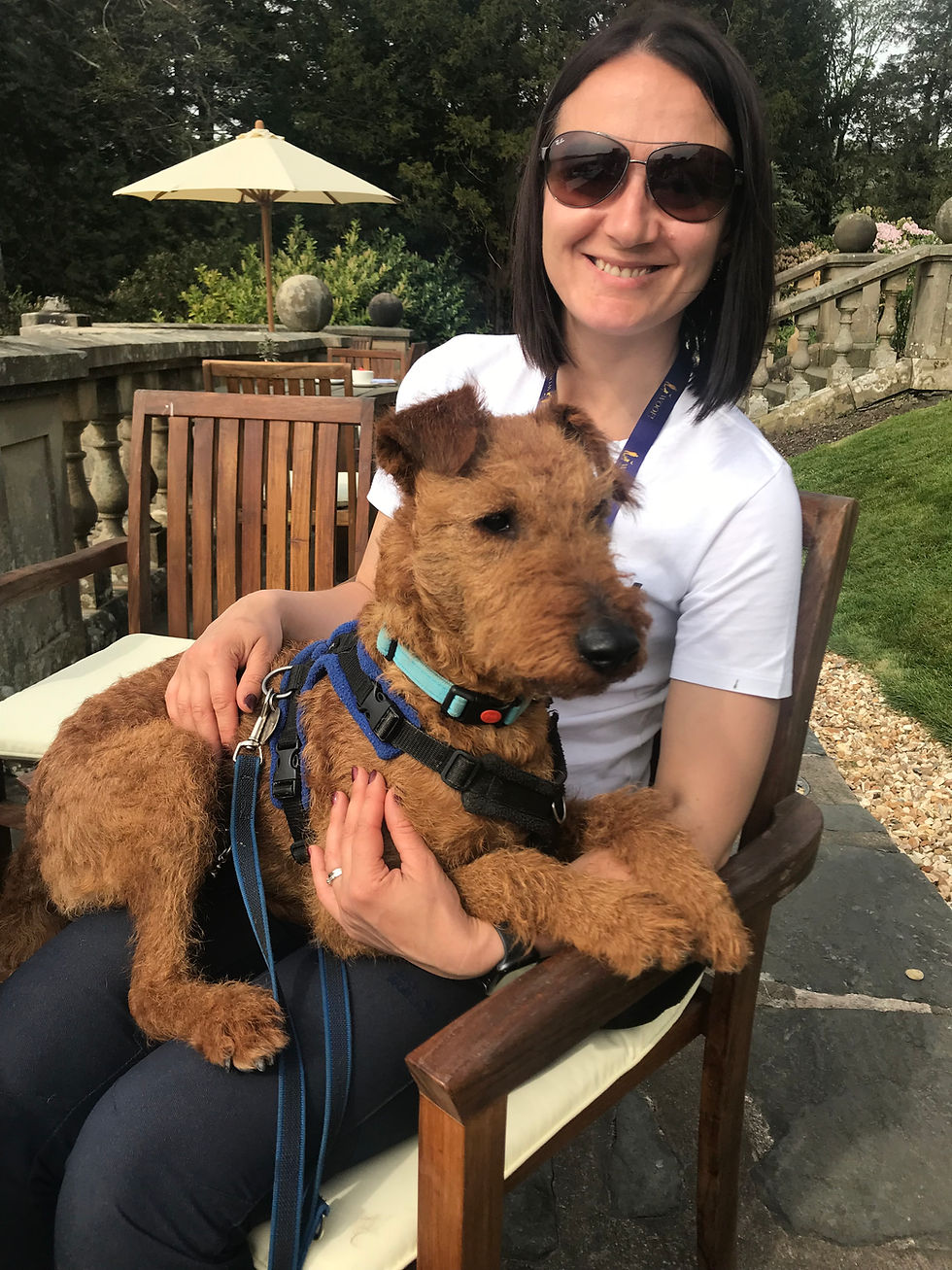
When Nika was seven, we brought home an Irish Terrier puppy called Monty. He never read the Irish Terrier manual - show him a rat and he'd scream and faint.
As a puppy he was perfect. Easy to toilet train, chewed nothing, lovely with everyone.
Then adolescence hit, and he was horrible. If there was a lamppost to pee on, I could wave steak in front of his nose and it wouldn't have mattered. Other dogs became the most important thing in his world, and his social skills didn't match his enthusiasm - he was stiff and square, and he rubbed dogs up the wrong way.
We survived it, and he grew into a wonderful, well-adjusted adult. These days Monty works as my stooge dog, helping dogs who struggle around other dogs to rebuild their social skills. The nightmare adolescent now teaches others how to be a dog.
And then there was Nero.
By 2019, Ian was deep into gun dog training, and we'd decided to rescue a spaniel (Nika was getting older then).
Then a puppy called Nessa joined one of my puppy classes and I had to google her breed: a Stabyhoun, a rare gun dog from the Netherlands.
Two weeks later, a post appeared in one of my training groups. A two-year-old male Stabyhoun, described as a project dog, was looking for a home. He had been booked in for euthanasia before his foster carer stepped in.
Nero arrived with severe separation anxiety and was reactive to almost everything - dogs, people, bikes, cars, a carrier bag blowing in the wind. He was so stressed he was self-mutilating, licking his paw pads until he took the skin off them.
He was petrified of children. For the first six months, we couldn't have visitors. I worked closely with our vet, and he went onto behaviour medication from day one, because life simply had too many triggers for him to cope with.
Nero is eight now. A few years ago I noticed that, almost without me spotting the moment it happened, he had become an easy dog to live with.
He's now children's best friend. He walks on and off lead, comes to the pub with us, and happily stays home alone when needed. He still tells adolescent male dogs not to jump on his head - and frankly, fair enough.
If you're living with a dog who feels impossible right now: I have lived it too. That's why there's no judgement here.
From rescuing the breed to preserving it.
Susie, the woman who saved Nero, turned out to be far more than a foster carer. She's a dog trainer and an experienced breeder who raises her litters with Puppy Culture - and she had a Stabyhoun of her own.
When she planned a litter, the timing wasn't perfect. It never is. Nika was eleven by then.
However, here's something I tell every prospective puppy owner: the breeder matters. Really, really matters. What happens in those first eight weeks shapes the dog you bring home. I knew Susie would raise an exceptional litter, so I put my name down for a little girl.
That's how Napa joined us - our second Stabyhoun. The Stabyhoun is a rare breed from the Netherlands, with only a small population worldwide. Napa passed all her health tests, and we made the decision to have puppies.
I raise my litters with Puppy Culture, which means socialisation starts in my living room, not in the new owner's.
One of Napa's first boys now lives in the States - so as part of his socialisation programme, I took him to Gatwick to hear the noise, see the crowds and walk on those shiny floors. Both puppies from that litter are now well-adjusted adults.
Then came Napa's singleton puppy, Elphaba - she was not going anywhere!
She's where everything I teach gets put into practice in real time.
So when I talk to you about the socialisation window, about what's normal and what needs attention, about how much those early weeks matter - I'm not quoting a textbook. I raise puppies. I live this side of it too.
The qualifications behind the stories.
-
OCN Level 5 accredited behaviourist
-
Accredited Animal Training Instructor (ATI) with the ABTC - the Animal Behaviour and Training Council, the UK's regulatory body for the sector
-
Registered member of the APDT (Association of Pet Dog Trainers), membership no. 01425
-
Full member of the UK Dog Behaviour and Training Charter
All of which is a long way of saying: everything I do here in the Reading area is force-free, science-led, and accountable to professional standards.
Force free doesn't mean boundary free - my dogs and my clients' dogs have structure, skills and manners. They just learn them without fear.
Dogs Be Dogs is bigger than me, though. Meet the people who make it what it is.



I was railroaded into all things dog by Tash. I never had a dog growing up - my dad was allergic, allegedly, though I've always suspected that was an excuse. Nika was my very first dog, and she's the one who got me hooked on gun dog training.
A few years after Tash started working with dogs professionally, I did the journey myself. I qualified with the IMDT, studied with some of the best force-free gundog trainers in the country, and went on to earn the highest force-free gun dog training qualification in the UK - qualifying as an instructor with the Gundog Trainers Academy.
When Nero arrived, gun dog training became a huge part of his rehabilitation. He and I are now working towards Grade 4 of the Gundog Club grades - a non-competitive assessment of a team's skills, and exactly the kind of partnership I build with my clients and their dogs.
I also run a small, specialist gun dog walking service across Reading and South Oxfordshire - the same dogs, the same handful of clients, week in, week out.
You'll rarely see me without my flat cap, and there's usually a dummy in my pocket or somewhere in the vehicle.
I'm also, according to Tash, a qualified wine snob - WSET Level 3, no less.
Ian Clark - Gundog Trainer

I have always loved animals. I fell in love with horses at the age of seven, despite no one else in my family feeling the same - and as soon as I had my first full-time job, I saved up and bought Niamh, a beautiful chestnut mare I owned and adored until she passed away.
I had always wanted a dog, but my job and the yard where Niamh was stabled made it impossible. As soon as my circumstances changed, we rehomed Ziggy, a three-year-old blue Staffy - cuddly, funny, loyal and completely ball obsessed. At the time I didn't see that as a problem, but I started to realise how anxious he was, and so I sought help.
That search led me to positive, science-based dog training.
I knew this was how I wanted to help Ziggy - but I also wanted to learn more for myself. Working with Tash taught me how to read dog body language, how dogs learn, and how behaviour change really works.
I went on to pass the extensive IMDT (Institute of Modern Dog Trainers) assessment to become a full member and trainer. I continue to learn from my incredible mentors at Dogs Be Dogs, and what I love most is helping owners build a strong relationship and a happy life with their dog.
Sarah Turner - Trainer
What our clients say
"The team at DogsbeDogs – Tash, Ian and Sarah – offer a well rounded and thought out programme of training from the very start of your dog owning journey.
When we brought our Stabyhoun puppy home at 8 weeks old we had a 1-2-1 with Tash to get the basics of training. She suggested that we start with socialisation visits to the vets and we can’t recommend that highly enough.
Puppy training with Sarah covered many aspects in a safe, well managed environment.
Progressing on to Recall training with Ian was another of our puppy’s new experiences. Learning with other puppies in a vast open space, their 15 acre secure field."
Paul, Sandra & Rowan
"We started puppy training with Dogs Be Dogs and have now moved on to the gundog classes with our 10 month old working lab, Bentley. The training has been fantastic!
The classes are really well run, with a great balance of training, socialisation and practical advice. It’s been especially useful as he’s got older and we’ve had to navigate the different stages that come with an energetic lab!"
Ellie & Bentley
Tash,
Thank you so much for all your help with Oscar's reactivity towards other dogs and for advising us to take him to the vets.
I took him to the vets today and showed her a picture of him lying down, and a video of him going up the stairs. She suggested that the 'bunny hop' was typical of hip dysplasia.
She did a thorough examination and manipulated all his legs and noticed that there was some stiffness in his right back leg.
Vet suggested an x-ray so we can see what is going on.
Linda, Justin & Oscar